The construction outlook for 2027 is cautious rather than bleak. The latest US data shows spending slipping, contractor backlogs shortening and fewer commercial projects entering planning, while forecasters still expect modest growth in building starts next year. For small contractors and estimators, the figures suggest a more selective bidding environment in 2027. Accurate quantities, current supplier prices and efficient estimating could become increasingly important as contractors compete for available projects.
This article pulls together the most recent figures from the US Census Bureau, Associated Builders and Contractors (ABC), Dodge Construction Network and the Associated General Contractors of America (AGC), with a short section on Australia. Then it looks at what those numbers mean for how you bid in 2027.
US Construction Outlook 2027: The Latest Numbers
Here is where the main indicators stood in mid-November 2026:
| Indicator | Latest reading | What it measures |
|---|---|---|
| US construction spending (Census) | $2,186.1 billion annual rate in September 2026, down 1.9% from August and 2.7% from September 2025 | Value of work put in place |
| ABC Construction Backlog Indicator | 8.1 months in October 2026, down 0.6 months from September | Work under contract, from ABC's member survey |
| Dodge Momentum Index | 260.4 in October 2026, down 9.0% from September | Nonresidential building projects entering planning |
| Dodge 2027 forecast | Residential starts +2%, nonresidential +1%, nonbuilding −10% (inflation-adjusted) | Expected construction starts in 2027 |
Construction spending, September 2026. The Census Bureau's 2 November release put total US construction spending at a seasonally adjusted annual rate of $2,186.1 billion, 1.9% below the revised August figure of $2,227.4 billion. For the first nine months of 2026, spending totaled $1,649.6 billion, 2.9% below the same period in 2025. Private construction fell 2.4% on the month. Although total spending fell, private nonresidential spending increased 1.1% from August to September, illustrating how the headline decline masks differences between sectors. The next release is due on 1 December 2026.
Backlog, October 2026. ABC's Construction Backlog Indicator fell to 8.1 months, based on a member survey run from 20 October to 3 November. That is 0.3 months lower than a year earlier.
Planning, October 2026. The Dodge Momentum Index fell 9.0% to 260.4. Commercial planning dropped 13.4% and institutional planning 1.5%. Dodge says the index leads nonresidential building spending by 12 to 18 months, which is why it matters for 2027.
These indicators measure different things. Spending is work already being built, backlog is work under contract, and the Momentum Index is projects entering planning. Together, the indicators suggest weaker conditions across several parts of the US construction market, although their coverage and timing differ. They do not establish that every region, trade or project type will slow in 2027.
Why Contractor Backlogs Are Shrinking
The headline 8.1 months hides a split. According to ABC, the 88% of surveyed contractors not working on data centers saw their backlog fall from 8.3 months in September to 7.6 months in October. Contractors with data center work saw theirs rise from 11.3 to 11.5 months, and most of those firms have over $100 million in annual revenue.
By category, infrastructure backlog fell to 8.7 months, its lowest level since May 2025, while heavy industrial backlog rose to a 15-month high.
ABC's Construction Confidence Index readings for sales and staffing fell in October, though all three components (sales, profit margins and staffing) stayed above 50, which signals expected growth over the next six months. ABC chief economist Anirban Basu noted that roughly 1 in 4 contractors still expect their margins to shrink.
Keep in mind that ABC's figure is an average from its surveyed members, not a measurement of every small business. Your own backlog may look very different, depending on your trade, region and client base.
Construction Forecast 2027: Which Sectors Could Grow?
Dodge's 2027 outlook, published on 28 October 2026, projects inflation-adjusted construction starts as follows:
- Residential: up 2%
- Nonresidential building: up 1%
- Nonbuilding (infrastructure and utilities): down 10%
Dodge also points out that much of the recent growth in commercial planning comes from data centers, and that the trend is far flatter without them. Its October Momentum Index backs this up: year over year, commercial planning was down 17.6%, but institutional planning was up 33.4%. Healthcare, public buildings and recreational facilities were among the sectors where planning picked up in October.
For small contractors, healthcare, public buildings and selected residential work may be worth monitoring. Institutional planning was higher than a year earlier, despite a slight monthly decline. These national indicators identify potential opportunities, not guaranteed growth in every local market.
Costs remain a pressure too. AGC reported on 13 November that the producer price index for inputs to new nonresidential construction rose 13.3% from October 2025 to October 2026, with longer lead times for structural steel and mineral wool insulation. We cover material prices in detail in construction material prices 2026.
What the 2027 Outlook Means for Small Contractors
None of this means every contractor will see a shrinking pipeline. But the construction market trends for 2027 point to a few likely effects:
- Potentially tougher bidding competition. Contractors with shorter backlogs may pursue more available projects, increasing competition in some trades and locations. Actual pressure will depend on local demand, project type and contractor capacity.
- More selective bidding. With fewer projects in some sectors, choosing which jobs to bid matters as much as how many.
- Less room for quantity errors. A missed wall run or a miscounted fixture costs more when the margin is thin.
- Faster turnaround. If you need to submit more bids to keep the same workload, the time each takeoff takes becomes a real constraint.
- Stale prices are a risk. With input costs still rising, a quote prepared weeks ago may no longer hold.
How Estimators Can Prepare for More Competitive Bidding
Whatever the 2027 market brings, estimators benefit from producing accurate, well-organized quantities without unnecessary rework. When it comes to construction bidding trends in 2027, that comes down to a few habits:
- Confirm the current revision before you measure, and recheck quantities when drawings change. See how to compare construction drawing revisions.
- Verify the scale on every sheet, including a second known dimension. See how to scale a PDF drawing accurately.
- Keep quantities organized by condition, so materials whose prices change can be repriced using previously verified quantities, provided the drawings and scope have not changed.
- Get current supplier quotes on volatile materials rather than reusing last quarter's rates.
- Run a final check before you submit, using our construction takeoff checklist.
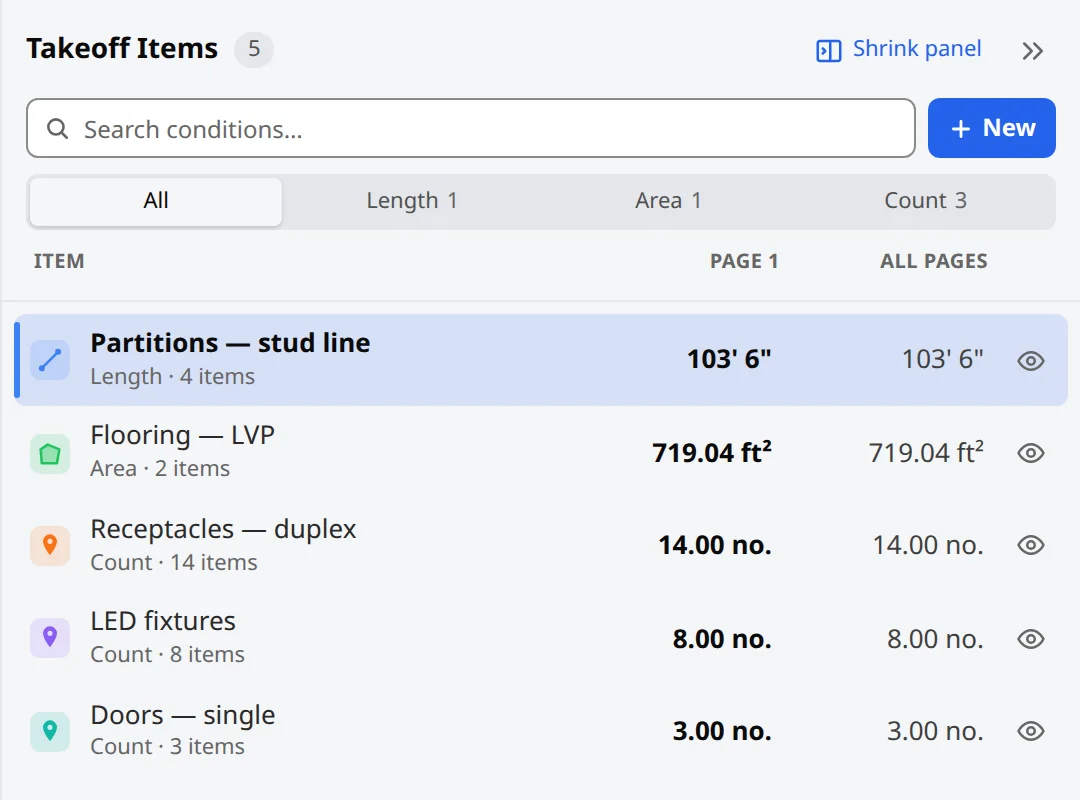
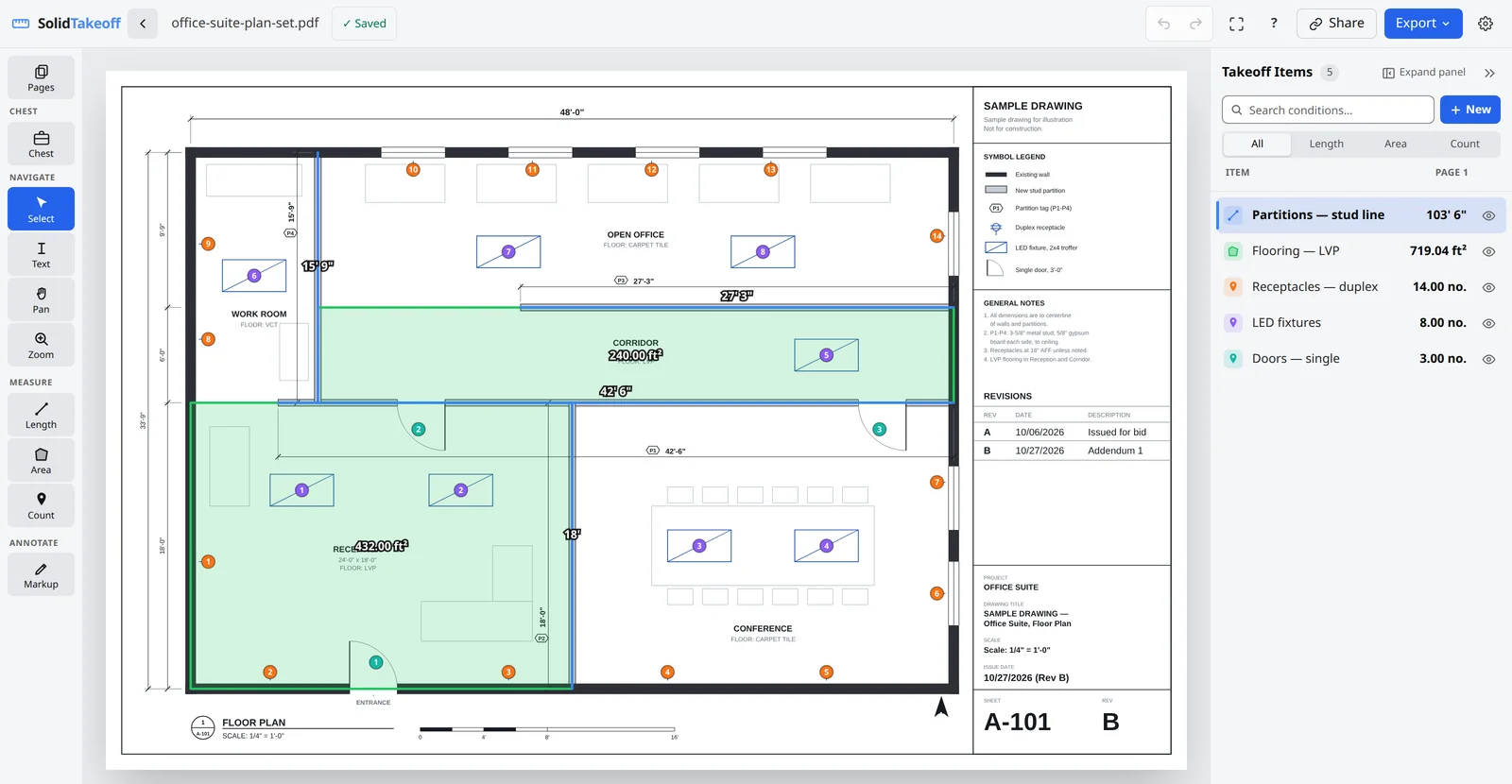
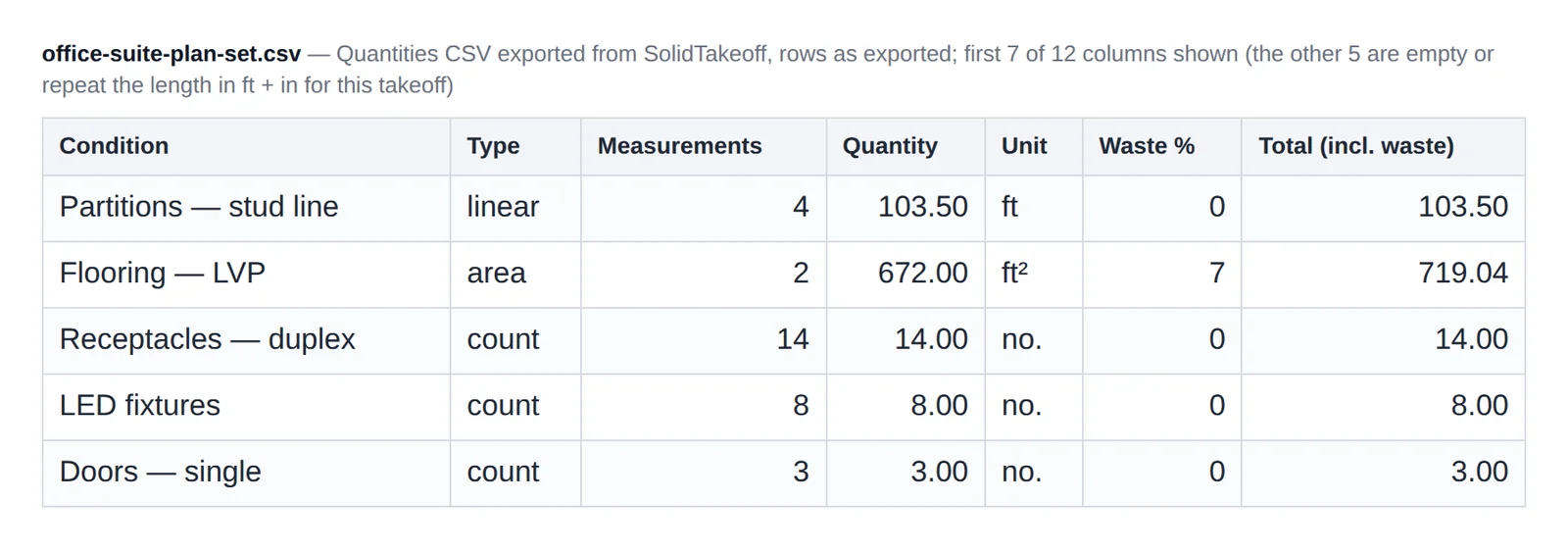
A browser-based takeoff tool can help with the measurement part of that work. SolidTakeoff lets you open a PDF drawing, calibrate the scale, measure lengths, areas and counts, group them into named conditions, and export the quantities to CSV or an annotated PDF for pricing. It does not win work or set prices for you. Using digital measurements, named conditions and reusable exports can reduce manual measuring and spreadsheet re-entry. The time saved will depend on the drawing set, project complexity and the estimator's existing workflow. The full method is in how to do a construction takeoff from PDF plans.
Five Steps to Prepare Your Construction Bids for 2027
- Review your pipeline by sector. Compare your mix of work with where planning is rising (institutional, healthcare) and falling (much of commercial outside data centers).
- Set bid/no-bid criteria. Decide in advance which project sizes, clients and locations you will chase, so estimating time goes to jobs you can win.
- Speed up takeoffs without losing accuracy. Measure directly from PDFs, check the scale, and keep conditions consistent across jobs.
- Refresh prices on every bid. Requote the materials that have moved, and apply new rates to quantities measured on the current drawings.
- Track your hit rate. Record which bids you win and lose, and why, so you can adjust where you spend estimating time.
Prepare your next bid with fewer measurement headaches. Measure quantities directly from PDF drawings, verify your takeoff and export the results for pricing. Try SolidTakeoff free — no credit card required.
The free plan includes 1 active project and 3 drawing uploads in total. Solo is $12.99 a month, and Team is $49.99 a month for three users, then $16.99 per extra user. Full details are on the pricing page.
Australia Construction Outlook 2027
Australia's latest figures are mixed. The Australian Bureau of Statistics reported that total dwelling approvals rose 5.1% in September 2026 (seasonally adjusted) to 17,948. Private sector house approvals, however, fell 5.3% to 10,432, and fell in every state reported. The value of non-residential building approved rose 45.9%, which Master Builders Australia attributed largely to major data centre projects.
According to Master Builders Australia, builders' forward books are becoming increasingly uncertain, and the association's own forecasts show new home building activity declining steadily over the coming years. Master Builders also said the cost of delivering new homes has risen by more than 50% since the pandemic.
For smaller Australian builders and trades, the same principles apply as in the US: be selective about what you tender, keep quantities accurate on the current revision, and refresh supplier pricing before you submit. Measure in metric units that match your bill of quantities, and do not apply US figures to an Australian tender.
Frequently Asked Questions About the 2027 Construction Outlook
What is the construction outlook for 2027? Cautious. Dodge forecasts inflation-adjusted residential starts up 2%, nonresidential building up 1% and nonbuilding work down 10% in 2027. Recent US indicators, including September spending and October backlog, have softened.
Is construction spending going down in the US? In September 2026, yes. Census data shows total spending 1.9% below August and 2.7% below September 2025. One month does not make a trend, so watch the 1 December release for October figures.
What is the construction backlog in 2026? ABC's Construction Backlog Indicator was 8.1 months in October 2026. For surveyed contractors without data center work, it was 7.6 months.
Which construction sectors look strongest for 2027? Data centers have driven much of the commercial planning growth. Outside them, Dodge's October data showed institutional planning up 33.4% year over year, with healthcare, public and recreational buildings picking up.
How can small contractors win more bids in 2027? Bid selectively, price from current supplier quotes, and make takeoffs faster and more accurate so you can submit competitive bids without extra hours. A construction takeoff checklist helps catch errors before you submit.
Figures are taken from the sources listed below and were checked on 18 November 2026. They are general market information, not financial advice.
Sources: US Census Bureau, Monthly Construction Spending, September 2026 (CB26-176), ABC, Dodge Momentum Index, Dodge 2027 trends, AGC, ABS Building Approvals, September 2026, Master Builders Australia.