Input costs for new nonresidential construction in the United States rose 11.9% in the 12 months through September 2026, according to the Associated General Contractors of America's analysis of Bureau of Labor Statistics producer price indexes. That is more than three times the 3.7% rise in the Consumer Price Index over the same period. Steel mill products, aluminum mill shapes and copper and brass mill shapes all increased by 25% or more.
The latest construction material prices in 2026 show why contractors need to review supplier quotations and measured quantities before submitting their next bid. Those figures are index movements, not the quote your supplier sent last week. They still matter before you bid: they show which materials have moved fastest, where lead times are stretching, and why a 30-day price hold may not cover the gap between bid day and procurement. Figures below are from the BLS September 2026 PPI release and AGC's October 2026 Construction Inflation Alert, checked on 13 November 2026.
US Construction Material Prices: What Changed in 2026?
AGC's 15 October 2026 news release and its October 2026 Construction Inflation Alert both use the producer price index for inputs to new nonresidential construction. That index is a weighted average of selling prices for most materials and some services used on nonresidential projects, not a contractor's bid price. AGC notes that it excludes contractors' direct labor costs, equipment purchases and direct imports of materials, though it does pick up imported goods bought through US distributors.
Year-over-year changes through September 2026, as reported by AGC from BLS data:
| Index | 12-month change to September 2026 |
|---|---|
| Copper and brass mill shapes | +30.0% |
| Steel mill products | +27.6% |
| Aluminum mill shapes | +25.2% |
| Inputs to new nonresidential construction | +11.9% |
These are producer price index movements, not supplier quotations. A distributor's price or a fabricator's bid can differ from the index, and can lag or lead it.
Not every product rose. In the same alert, the PPI for cement declined 1.2% over those 12 months, while precast construction products, which have steel embedded in the concrete, increased 10.5%. From February 2020 through September 2026, the nonresidential input PPI rose 58%, against a 30% rise in the CPI. Owners relying solely on general consumer inflation to update construction budgets risk underestimating changes in material and delivery costs, particularly on projects with significant exposure to metals. Fuel added more pressure: AGC reported the diesel fuel producer price index up approximately 115% year over year through September 2026, and truck transportation of freight up 19.3%.
AGC attributes much of the metals increase to tariffs imposed in 2025, including duties of 50% on most imported steel and aluminum and a 50% tariff on the copper content of many products. Treat that as background for why mill prices moved, not as a complete account of every duty now in force. Your supplier's quote is still the number that belongs in the bid.
Steel, Copper and Aluminium: Which Contractors Are Most Exposed?
The 11.9% figure averages very different trades. If your package is heavy in steel, copper or aluminum, the relevant index is much steeper.
Structural and miscellaneous metals. Steel mill products are up 27.6%, which flows into beams, joists, deck, lintels and many fabricated assemblies. AGC's Inflation Alert also cites a narrower series: the PPI for fabricated structural metal for non-industrial buildings, such as beams and joists, climbed 35% from September 2025 to September 2026. These figures measure different product groups and are not contradictory. The 35% increase applies specifically to fabricated structural metal for non-industrial buildings, as cited by AGC. The 7.4% increase applies to the broader fabricated structural metal products index (WPU107). Neither represents a universal increase in fabricated steel quotations. (The September 2026 WPU107 figure is preliminary in the BLS data and in Consight's PPI table.) Use the exact index name if you discuss either number with an owner or a steel sub, and ask when the mill quote behind a fabricator's price is dated.
Price is only half of the steel problem. AGC reported that by late September some fabricators had already reserved all capacity through the first quarter of 2027, or longer. Some contractors were warned they would receive as little as one-fourth of the beams they had contracted for, and other fabricators were turning down new customers.
Electrical, plumbing and mechanical. Copper and brass mill shapes are up 30.0%, which hits conductors, pipe, fittings and tubing. Aluminum mill shapes are up 25.2%, which matters for storefront, curtain wall and windows. If those materials sit inside a spring lump-sum number, refresh the quote before you reuse it.
Fit-out and interiors. The October tariff changes also cover selected finishes, flooring, coatings and valves, making them relevant to fit-out contractors as well as other construction trades.
How the Latest US Tariffs Affect Construction Materials
The metals tariffs from 2025 are one story. A separate, narrower action took effect at 12:01 a.m. Eastern time on 30 October 2026.
A 23 October 2026 White House fact sheet and the Federal Register proclamation confirm that specified products of Canada were added to, and others removed from, the additional 50% ad valorem Section 338 duty, for goods entered on or after that date. The fact sheet states that these tariffs apply to all covered goods regardless of USMCA origin, and in addition to tariffs imposed under Section 232.
This is a product-specific list, not a blanket tariff on all Canadian construction materials. The fact sheet describes removals such as plywood sheets, some paper products, certain machinery and refrigeration equipment, and certain packing crates and boxes, and additions that include certain valves, carpets and other named goods. ConstructConnect's 10 November report reads the construction impact as falling mainly on finishes, fixtures and mechanical components, including selected vinyl flooring and carpet, some wood and panels, iron or steel taps and valves, caulk, and acrylic and vinyl paints.
Whether that changes your bid depends on origin and scope. Ask suppliers which items are imported from Canada, which tariff classification they use, and whether the 30 October change is already in the quoted price. Do not apply a 50% bump to an entire interior package on the assumption that every line is covered.
What Rising Material Prices Mean for Construction Bids
Quotation validity. A supplier price marked "valid for 15 days" can expire before award, let alone before the material is released. Compare the hold period with your expected award and procurement dates, not with bid day alone. If the hold is shorter than that gap, the bid needs a refreshed quote, an allowance, or a contract term that says who pays if the price moves.
Illustrative example (hypothetical supplier quotations, not market data):
| Item | Previous quote | New quote | Difference |
|---|---|---|---|
| Electrical materials | $12,000 | $13,800 | +$1,800 |
| Steel package | $20,000 | $24,000 | +$4,000 |
| Combined | $32,000 | $37,800 | +$5,800 |
Lead times. AGC's late-September reports of fabricators booked into early 2027 mean a low steel price is worthless if the material cannot arrive on schedule. Confirm fabricator slots in writing, and state the lead time you have assumed.
Escalation and risk allowances. On a lump-sum bid, unexplained material inflation often sits with the contractor unless the contract says otherwise. AGC has urged parties to consider price-adjustment clauses that share the risk of unusual material-price swings, which can reduce the need for a large contingency. Construction counsel, including an October 2026 briefing on escalation clauses, treats those clauses as a way to allocate risk, not as a form that automatically protects you.
This is not legal advice. Escalation language varies: which materials are covered, what index or actual-cost proof is used, what threshold or cap applies, and whether tariffs are named as a triggering event. Review any clause with your own adviser. If you use an index, name the series and the base month.
Five Steps to Protect Your Next Construction Bid
Refresh supplier prices on the volatile lines. Do not reuse a spring quote for steel, copper, aluminum or any finish now on a new tariff list. Ask for the date of the mill or distributor quote behind the number, and how long the price will be held.
Verify the quantities those prices will be applied to. A correct unit rate on an outdated takeoff still produces a wrong bid. Confirm you are measuring the latest revision, then recheck lengths, areas and counts for the packages whose prices have moved. Use the construction takeoff checklist before you lock the number.
Identify the volatile materials and split them out. Keep structural steel separate from miscellaneous metals, copper pipe separate from fixtures, and tariff-exposed finishes separate from the rest of the interior package.
Document the assumptions. Write down the quote date, validity period, lead time, origin (domestic or imported), waste percentage and any allowance. If the drawings leave a quantity unclear, record what you bid and why.
Review the contractual protections with your own adviser. Look at whether the bid form or the prime contract allows a material escalation, an allowance or a tariff adjustment, and whether those terms flow down to subcontractors. If they do not, decide whether the remaining risk sits in a contingency or whether you will qualify the bid.
How to Recheck Material Quantities When Prices Change
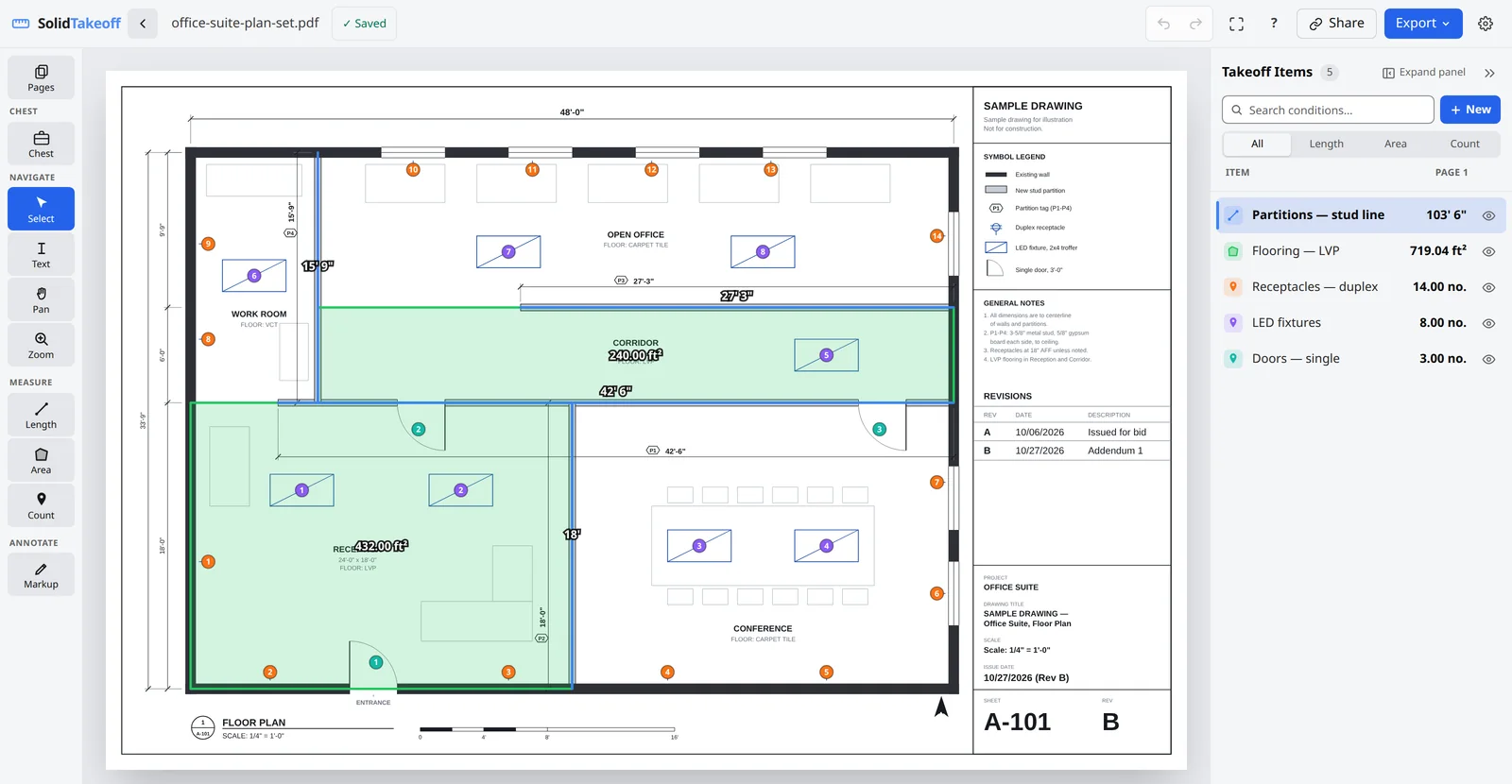
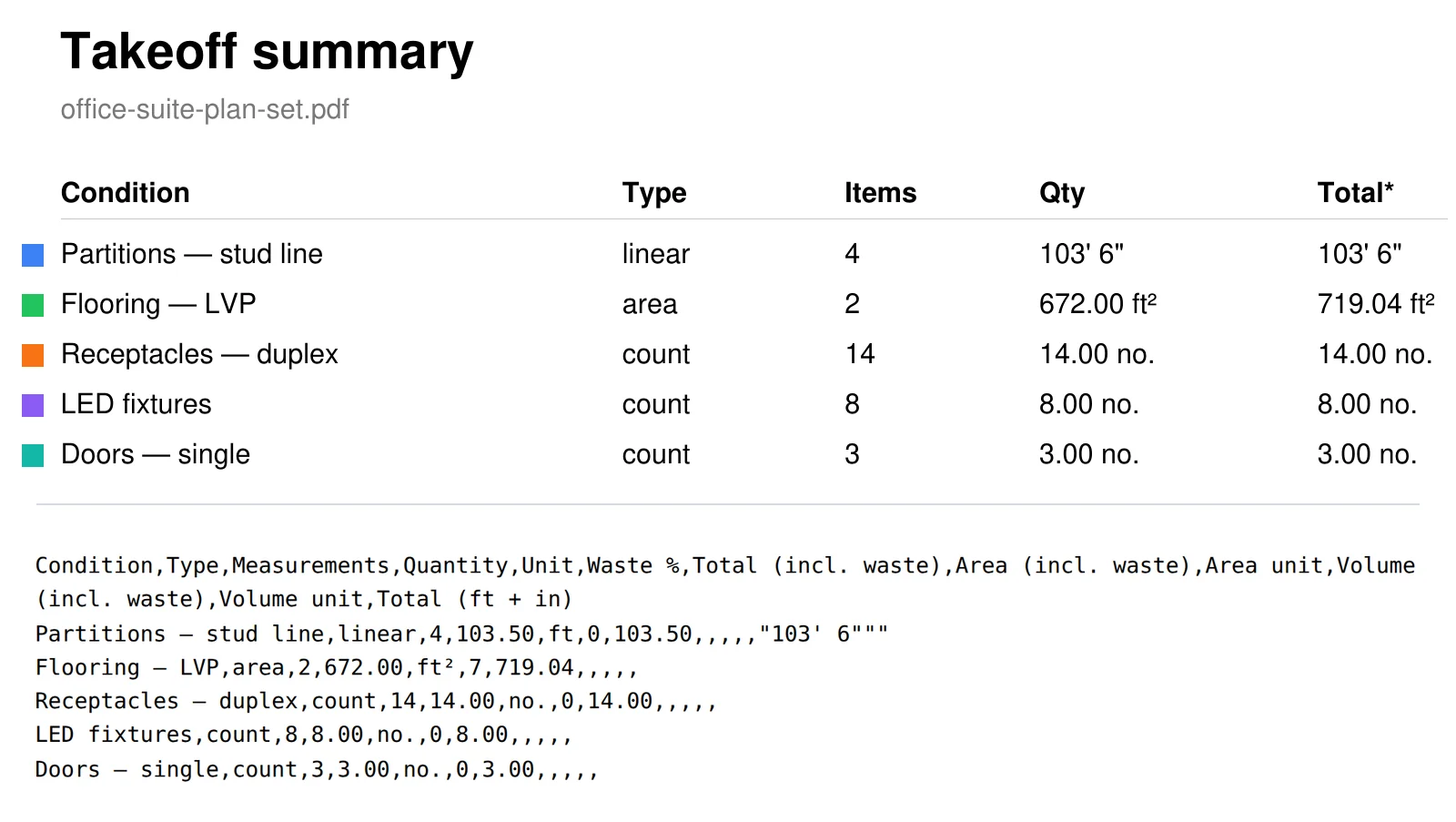
When a unit price jumps, confirm the quantities before you overwrite the rate in the spreadsheet. Open the latest PDF set and confirm the revision. Verify scale on every sheet you will remeasure, including a second known dimension. Remeasure the affected conditions — linear feet, areas and counts — and keep dissimilar materials in separate conditions. Export the quantities and apply the new supplier prices in your estimating spreadsheet.
The full method is in how to do a construction takeoff from PDF plans. Run the checklist above once the quantities are updated.
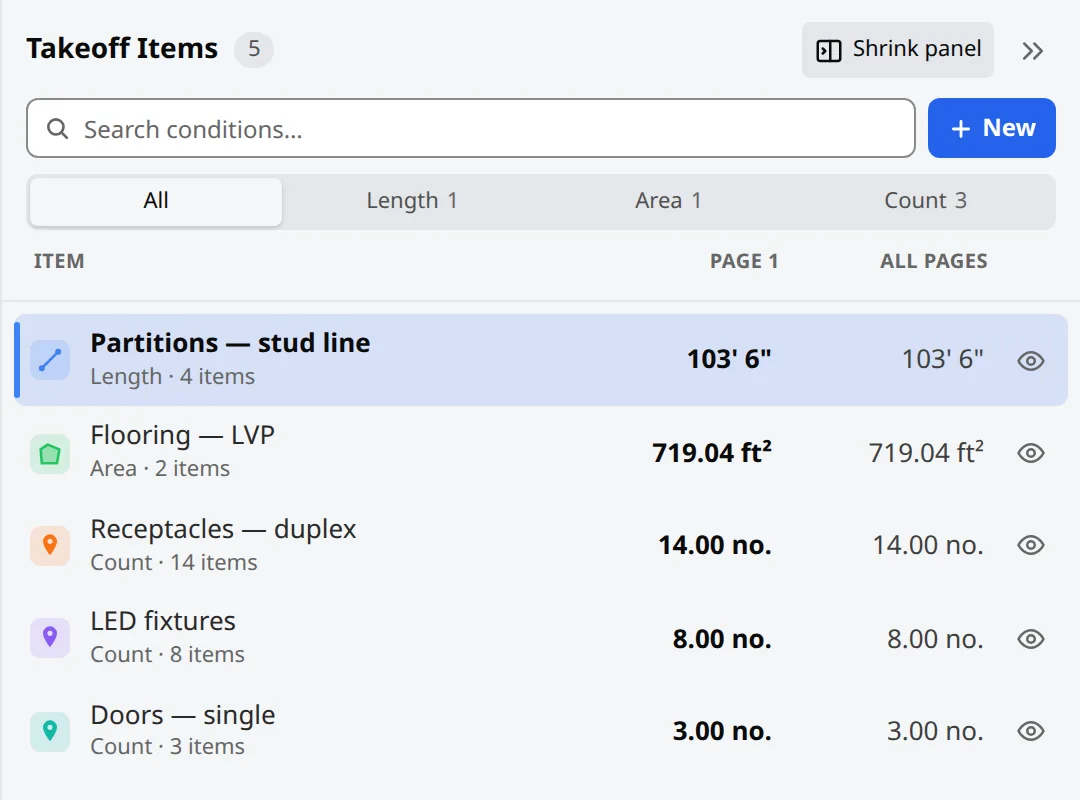
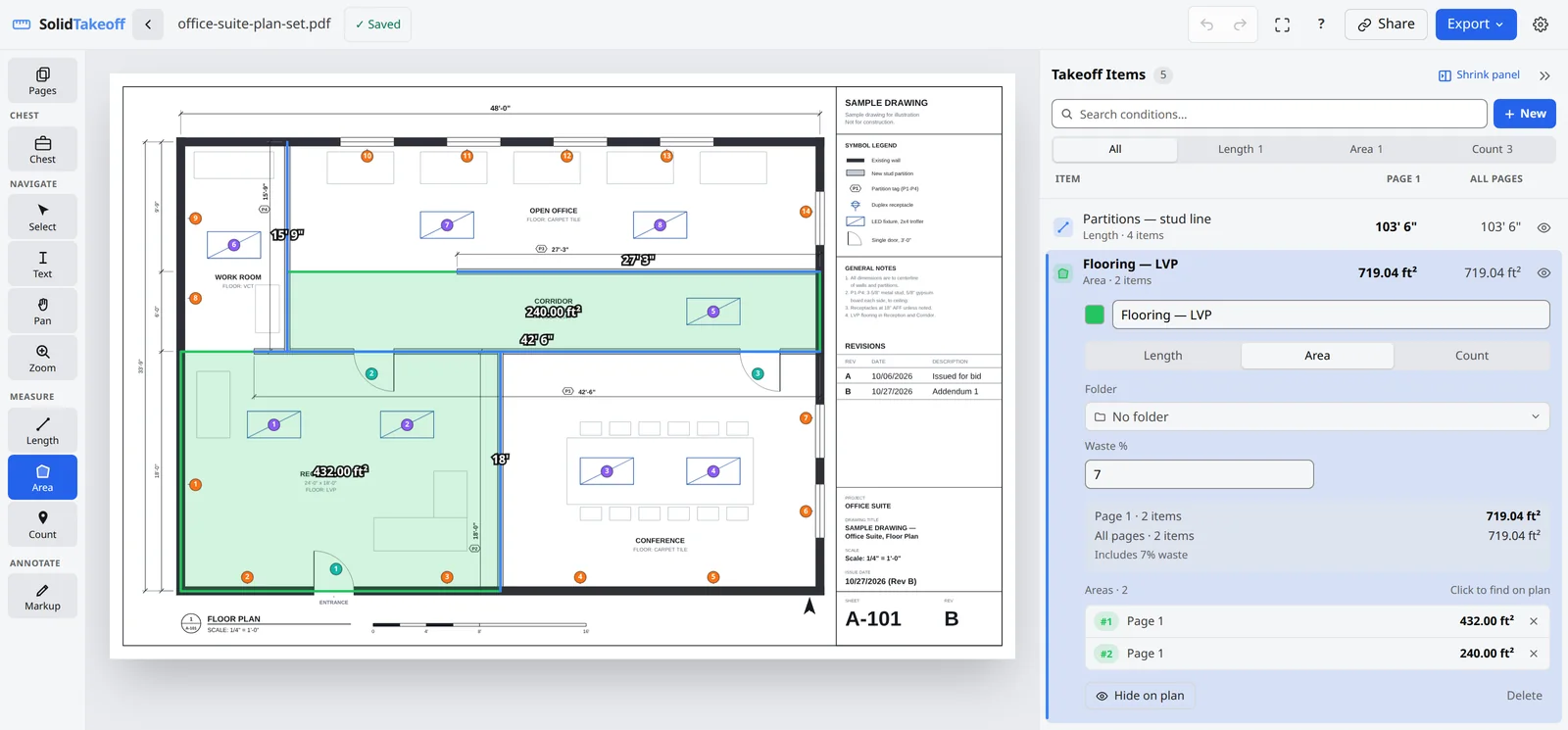
SolidTakeoff can help with that recheck, and it is worth being precise about what it does and does not do. It measures quantities from PDF drawings, photos or scans — lengths, areas and counts — with scale calibration and PDF or CSV export. It does not control supplier prices, and it does not automatically protect a bid against cost escalation. The commercial value is that you can remeasure the affected work, keep volatile materials in their own conditions, and export quantities to a spreadsheet for updated pricing.
If you need a free tool for that remeasurement, see best free construction takeoff software in 2026. You can start in the browser with no signup, or create a free account: 1 active project and 3 drawing uploads in total, with Solo at $12.99 a month and Team at $49.99 a month for three users, then $16.99 per extra user. Full plan detail is on the pricing page.
Recheck the quantities on your next bid in SolidTakeoff. Open a PDF, verify the scale, remeasure the affected conditions and export the results to update your pricing. Free to start, with no credit card required. Start free →
Australia: Construction Material Cost Trends in 2026
Australian builders are not seeing the same pace of increase, and the indexes are not directly comparable with the US nonresidential input PPI.
Cotality's Cordell Construction Cost Index, published on 21 October 2026, recorded a 1.0% increase in construction costs nationally in the September quarter, and a 3.2% increase over the 12 months to September 2026, up from 2.8% in the previous quarter. Cotality said the rate remains below typical post-pandemic levels.
For metric tender sets, the practical steps are the same: refresh supplier quotes, remeasure quantities on the current revision, and keep volatile items in their own takeoff conditions with units that match the bill of quantities. Do not apply the US 11.9% figure, or US tariff rates, to an Australian tender.
Frequently Asked Questions About Construction Material Prices
How much have US construction material prices risen in 2026? The PPI for inputs to new nonresidential construction rose 11.9% from September 2025 to September 2026, according to AGC's 15 October 2026 analysis of BLS data. That index covers materials and some services, not a contractor's full bid, and compares with a 3.7% rise in the CPI.
Which construction materials increased the most? Among the series AGC highlighted, copper and brass mill shapes rose 30.0%, steel mill products 27.6% and aluminum mill shapes 25.2%. A narrower PPI for fabricated structural metal for non-industrial buildings rose 35%; the broader fabricated structural metal products series (WPU107) rose 7.4%. Those are different indexes.
Do the 30 October 2026 tariffs apply to all Canadian construction materials? No. They are product-specific modifications to the Section 338 list, effective 30 October 2026. Some products were added and some, including certain plywood sheets, were removed. The duties apply to covered goods regardless of USMCA origin and in addition to Section 232 tariffs, according to the White House fact sheet and the Federal Register proclamation. Check the classification and origin of each product with your supplier.
Should I add 11.9% to every bid? No. That figure is a broad input-cost index, not a recommended markup. Requote the materials that have actually moved, using current supplier prices and the quantities on the current drawings.
Can takeoff software protect me from material-price escalation? No. A takeoff tool measures quantities. It does not set supplier prices or write contract terms. What it can do is help you remeasure the affected work and export clean quantities so the new prices are applied to the right amounts. See how to do a construction takeoff from PDF plans.
Is this legal advice on escalation clauses? No. The notes above are general practice points only. Have your own adviser review the contract language on your project before you rely on an escalation, allowance, change-in-law or similar term.